Guides
Veterinary practice management: Texas TBVME and OSHA duties
Veterinary practice management in Texas: TBVME licensing, CE and complaint steps for a clinic, plus the federal OSHA standards an animal hospital must meet.
What to take away
- Veterinary practice management in Texas runs on two tracksTexas Board of Veterinary Medical Examiners licensing and OSHA workplace rules.
- The board licenses veterinarians and registered veterinary technicians, investigates complaints and can suspend, fine or revoke.
- Texas has no state-run OSHA plan, so federal OSHA enforces in the state through its Texas offices.
- Radiography, anesthesia and sharps hazards carry their own written programs, training and equipment duties.
- Bloodborne pathogens and hazard communication rules require an exposure control plan, labels and training records.
- The OSHA workplace poster and worker rights obligations must be posted and explained to staff.
Texas Board of Veterinary Medical Examiners: licensing and renewal
The Texas Board of Veterinary Medical Examiners (TBVME) is the state agency created by the Texas Veterinary Practice Act. Its administrative rules sit in Title 22 of the Texas Administrative Code, Chapter 573, which is where licensing, renewal and complaint procedure are written down. It licenses veterinarians and registered veterinary technicians, sets practice standards, and disciplines licensees.
Veterinarian Texas License Steps
- Graduate AVMA-accredited veterinary program
- Pass NAVLE examination
- Apply to TBVME with transcripts and fee
- Complete fingerprint criminal background check
- Receive license and renew with CE
The AVMA keeps a state-by-state overview of how practice acts and licensure work, which is useful for comparing Texas with the states your relief vets come from.
A Texas veterinary license follows a fixed sequence: an accredited veterinary program, the national licensing examination (the NAVLE), a completed board application, and renewal to keep the license active. Each step has to be finished before the next one counts, and the gap between finishing school and holding a Texas license is where new hires most often stall.
Registered veterinary technicians follow a parallel path: accredited technician program, Veterinary Technician National Examination, board application and renewal. A practice that hires a technician who has not yet completed the Texas application is exposing itself to an unlicensed practice finding. Check status before the first shift.
Renewal is not paperwork for its own sake. Continuing education, the jurisprudence requirement and timely fee payment keep the license active, and the board sets the continuing education minimum by rule. Texas requires a veterinarian to complete two hours of opioid-related continuing education every two years to renew a license to practice veterinary medicine, covering controlled substance diversion, inventory and security. A lapsed license means the person cannot legally practice, and the clinic cannot bill for that work. Put renewal dates in the same calendar you use for DEA registration and rabies vaccinations.
New owners often ask which licenses the building itself needs, separate from the people. That is a different list, covering entity registration, sales tax, radiology equipment registration, DEA and local permits. See Licensing a veterinary practice for the entity-level side.
Licensing a veterinary practice is a project with its own deadlines, and it is worth mapping before you sign a lease.
Keep a credential file for every licensed person: license number, expiration, CE certificates, and any board orders. When the board or an insurer asks, you produce it the same day.
Complaint steps and what a board investigation looks like
A board complaint can start with a client, a former employee, another veterinarian, or a pharmacy. The TBVME screens the complaint, decides whether it falls within its jurisdiction, and either dismisses it or opens an investigation. You will typically learn about it by mail, not by phone.
Board Complaint Investigation Flow
- Complaint screened for jurisdiction
- Notice mailed, records requested
- Investigator reviews records and statements
- Informal settlement or formal hearing
- Board issues findings and sanctions
What happens next follows a recognizable sequence.
- The board sends notice of the complaint and requests a written response and records; the notice states the deadline for your response, so calendar it the day it arrives.
- An investigator or board staff attorney reviews medical records, invoices, and witness statements.
- The board may offer an informal settlement, often with conditions such as CE, monitoring or a reprimand.
- If the matter is contested, it moves to a formal hearing under the state's administrative procedure rules.
- The board issues findings and, if warranted, sanctionsfine, suspension, probation or revocation.
Two things decide most outcomes: the medical record and your tone in the response. Records that are complete, signed, timed and legible make a defensible case. Records with gaps or late addenda invite a harsher reading. Answer factually, avoid speculation about the complainant, and never alter a record after the fact.
If the complaint involves a client dispute, treat it as a service recovery problem first. Responding early, documenting the conversation, and resolving billing or care concerns before they escalate keeps most disputes out of the board's hands.
If the complaint involves a controlled substance, expect parallel attention from the DEA and the board. Keep your controlled substance log, biennial inventory and power of attorney documents current.
OSHA in Texas: federal enforcement and state contacts
Texas does not operate its own OSHA-approved State Plan for private-sector employers. Federal OSHA covers Texas workplaces directly, including veterinary clinics. The State Plans page explains how state-run programs work and confirms which states run them, which is the quickest way to check that Texas is federal: State Plans | Occupational Safety and Health Administration.
Enforcement in Texas comes through the federal OSHA regional and area offices. Inspections can be programmed (targeted at industries with high injury rates), or unprogrammed after a complaint, a referral, or a serious incident such as an amputation or a fatality. A written employee complaint can trigger an on-site inspection; OSHA generally does not reveal the complainant.
To reach the right office, use the federal directory rather than a general number: OSHA Offices by State | Occupational Safety and Health Administration. Save the Texas area office contact you find there in your phone and in your safety binder. If an inspector arrives, ask for credentials, call your compliance lead or attorney, and accompany the walkaround.
Penalties for repeat or willful violations cost far more than a first citation, and the practical point is not the maximum penalty. It is that small clinics get cited for the same handful of hazards: no written programs, no training records, unlabeled containers, and blocked exits. If a citation is issued, every violation carries its own abatement date, abatement can require written certification, and an employer has 15 working days from receipt to contest the citation before the Occupational Safety and Health Review Commission.
A veterinary practice that already documents its clinical protocols is halfway to OSHA readiness. Your written operating procedures for the daily grind, cleaning, radiography, anesthesia and sharps handling, double as safety documents when they include the hazard controls.
Radiography, anesthesia and sharps hazards in a clinic
Radiography is the hazard most Texas clinics underestimate. OSHA's ionizing radiation standard, 29 CFR 1910.1096, expects a written radiation safety program, a designated radiation safety officer, restricted access to the radiology area, personnel monitoring (badges) where required, and training for everyone who takes or assists with radiographs. The machine itself is registered with the Texas Department of State Health Services Radiation Control Program, whose radiation machine rules sit in Title 25 of the Texas Administrative Code.
Clinic Hazard Duties and Records
Hazard
- Radiography
- Written radiation safety program
- Anesthesia
- Scavenging, cylinder storage, electrical safety
- Sharps
- Puncture-resistant containers, no hand recapping
Core OSHA duty
- Radiography
- Training rosters, badge reports
- Anesthesia
- Service records, gas checks
- Sharps
- Sharps injury log
Records to keep
- Radiography
- Anesthesia
- Sharps

Lead aprons and thyroid shields must be inspected and stored flat, not folded. If you use portable units, the same rules follow the machine.
Anesthesia brings waste gas exposure, oxygen handling, and electrical safety. Scavenging systems must be working and tested. Compressed gas cylinders need secure storage, caps when not in use, and separation from ignition sources. Waste anesthetic gas monitoring is not universally mandated, but it is the clearest way to show you evaluated the exposure.
Sharps are the injury source that generates the most OSHA paperwork. Requirements include puncture-resistant sharps containers placed close to use, no recapping by hand, prompt disposal, and a log of sharps injuries. A sharps injury triggers evaluation, follow-up and recordkeeping under the bloodborne pathogens standard.
Radiography, anesthesia and sharps hazards
| Hazard | Core OSHA duty | Records to keep |
|---|---|---|
| Radiography | Written radiation safety program, training, monitoring | Training rosters, badge reports, equipment checks |
| Anesthesia | Scavenging, cylinder storage, electrical safety | Service records, gas checks |
| Sharps | Engineered containers, no recapping, injury log | Sharps injury log, evaluation notes |
| Chemicals | Labels, safety data sheets, training | SDS binder, training records |
A worked example: a small animal clinic in Texas buys a used radiography unit. Before the first exposure, the owner names a radiation safety officer, writes a two-page program, orders badges for two technicians, trains all staff who will hold animals, and files the training sheets.
The point is to have the program in place before the first exposure, not after an inspection. A citation disrupts the schedule and pulls the owner's attention away from patients.
Bloodborne pathogens, hazard communication and recordkeeping duties
Veterinary staff face blood, saliva, urine and tissue exposure daily. OSHA's bloodborne pathogens standard, 29 CFR 1910.1030, requires a written exposure control plan, updated annually, that lists job classifications with exposure risk and the tasks that create it.
Bloodborne Pathogens Compliance Checklist
- Written exposure control plan updated annually
- Hepatitis B vaccination offered at no cost
- Personal protective equipment provided
- Safe work practices enforced
- Post-exposure evaluation and follow-up
- Training at hire and annually with records
It also requires hepatitis B vaccination offered at no cost, personal protective equipment, safe work practices, and post-exposure evaluation and follow-up. Review the standard's scope and requirements here: Bloodborne Pathogens - Overview | Occupational Safety and Health Administration.
Training must happen at hire and at least annually, with a knowledgeable trainer and a record of who attended and when. The training record is what an inspector asks for first. If you cannot produce it, the citation is easy.
Hazard communication, 29 CFR 1910.1200, covers the chemicals in your treatment room, lab, laundry and kennel: disinfectants, formalin, x-ray processing chemicals, oxygen and anesthetic agents. Requirements include a written program, a current safety data sheet for each hazardous chemical, labels that are not defaced, and training on how to read an SDS and use the chemical safely.
OSHA's overview is here: Hazard Communication - Overview | Occupational Safety and Health Administration.
Recordkeeping duties split into two buckets. Injury and illness records under 29 CFR 1904 (OSHA Forms 300, 300A and 301) apply to most clinics with more than ten employees, and the 300A summary must be posted from February 1 through April 30.
Separately, you keep training records, exposure records, sharps injury logs and medical records, each with its own retention period. Medical records stay confidential and are not kept in the personnel file.
A new owner can get lost in the overlap between clinical and safety paperwork. The broader guide to licences, filings and checks is a useful map.
The workplace poster and worker rights obligations
OSHA requires most employers to post the federal workplace poster, "It's the Law," where employees can see it. In Texas, that is the federal poster, not a state version. The poster tells workers their rights: to request an inspection, to participate in one, to see citations, and to report injuries without retaliation.
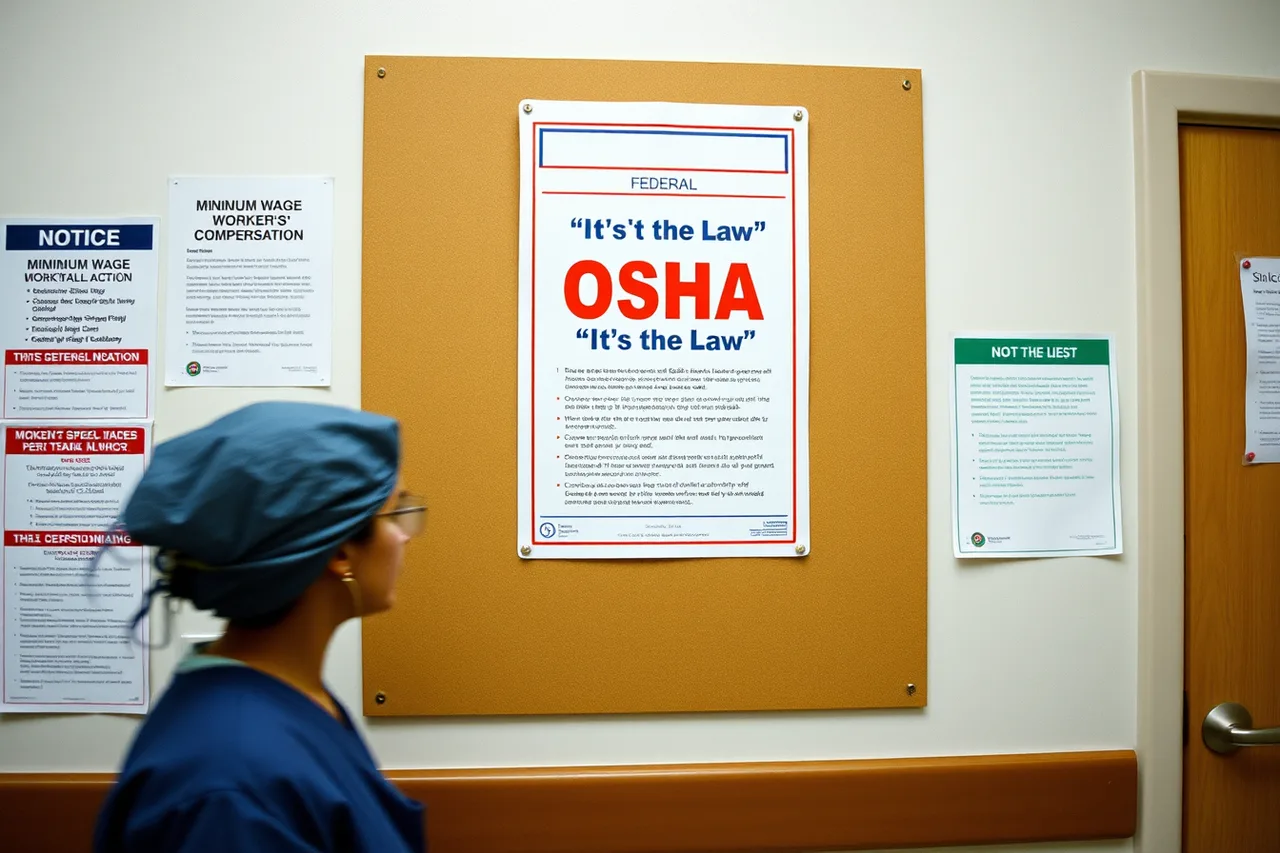
Posting is not enough on its own. You must also tell employees where to find the poster, how to report a hazard, and that retaliation for raising a safety concern is illegal. Document that you covered it in orientation. If you use an electronic posting system, confirm it meets the posting rules for your workforce.
Other posters belong on the same board: minimum wage, unemployment insurance, workers' compensation and payday law notices. A cluttered board is still a compliant board if every required notice is present and readable. Check the board during your monthly walkthrough.
Anti-retaliation is the obligation owners forget. A technician who reports a needlestick or a broken scavenger system is protected. Disciplining that person, even for an unrelated reason shortly after, invites an OSHA whistleblower complaint. Keep the reporting channel simple and the response documented.
Preparing for an inspection without a scramble
Readiness is a binder and a habit, not a weekend project. Use this checklist and refresh it quarterly.
Inspection Readiness Binder Checklist
- Current licenses with renewal dates tracked
- Exposure control plan reviewed within last year
- Radiation safety program with named officer
- Safety data sheets in labeled binder
- Sharps containers mounted and injury log
- OSHA 300A summary posted February through April
- Federal workplace poster visible to all staff
Assign one person as compliance lead and one backup. Give them authority to stop unsafe work. Run a self-inspection twice a year using the same hazard list an inspector would use, and fix what you find before someone else finds it.
If you are opening a new clinic, build the safety documents alongside your clinical protocols. The requirements to open a veterinary practice include permits, equipment and staffing decisions that are easier to get right when the safety program is designed at the same time.
When an inspector arrives, be calm, be accurate, and do not volunteer documents you were not asked for. Take notes, ask for the scope of the inspection, and correct any hazard found during the walkaround. Prompt correction is a mitigating factor in penalty decisions.